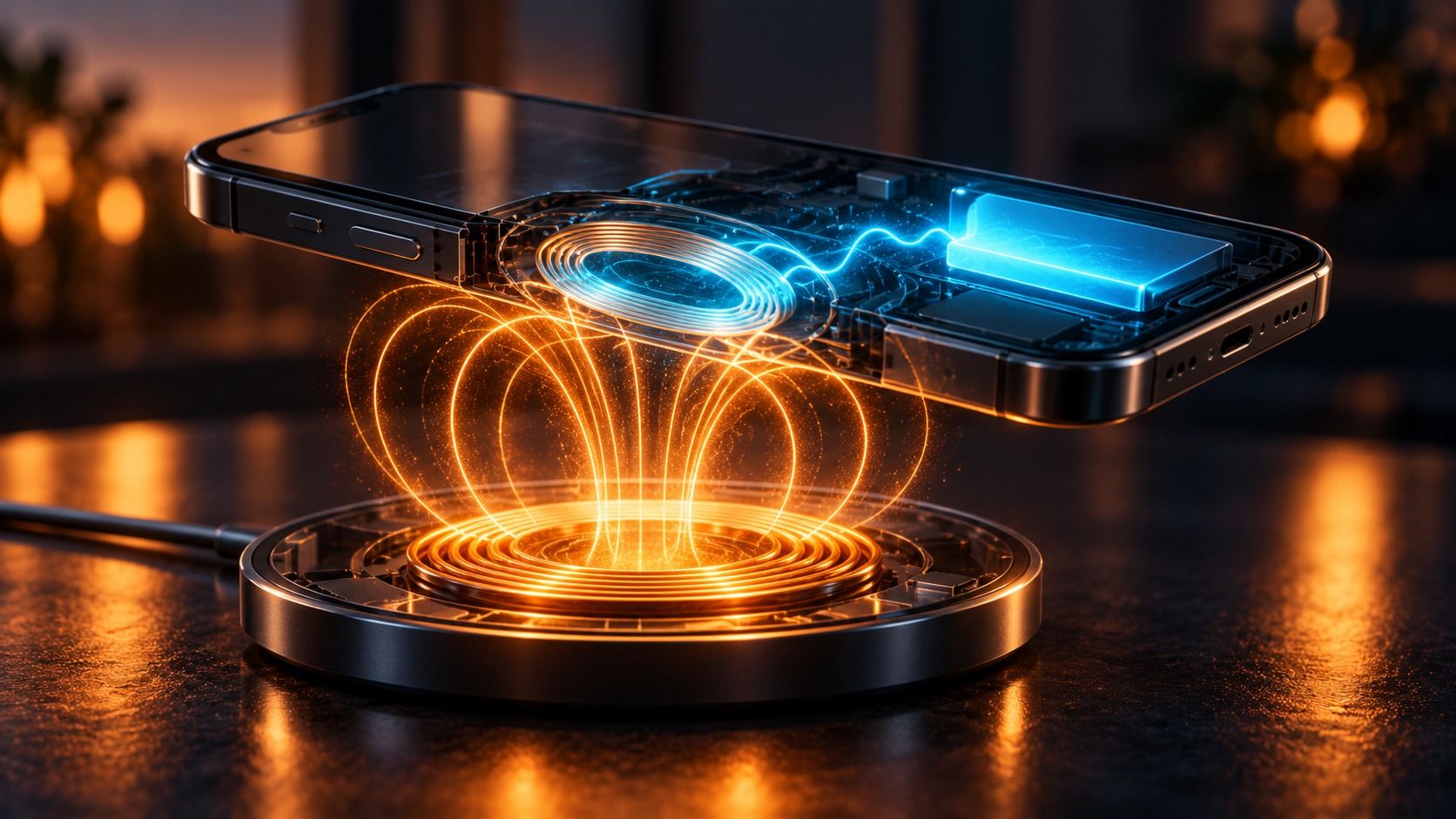
How does wireless charging work?
A coil in the charging pad creates a changing magnetic field. A second coil inside your phone picks up that field and turns it back into electricity for the battery.
The pad makes a magnetic field
Inside the pad is a flat coil of copper wire. Electricity runs through it back and forth, many thousands of times a second, creating a magnetic field that keeps changing direction.
Share this stepThe phone catches the field
A matching coil sits inside the back of your phone. The changing field passing through it pushes electrons along the wire, which creates an electric current. No cable needed.
Share this stepThe current fills the battery
A small chip converts the current into the steady kind of electricity the battery needs, and the battery starts charging. The coils have to be close and lined up, which is why position on the pad matters.
Share this stepTwo coils, one invisible bridge.
Electricitymagnetismelectricity
It’s the same trick that charges electric toothbrushes. It’s convenient, but slightly slower and less efficient than a cable, because some energy is lost as heat.
Common follow-up questions
Is wireless charging bad for my battery?
Not really. Heat is what wears batteries down, and wireless charging runs a bit warmer, but modern phones manage temperature and slow the charging if needed.
Why does my phone have to be in the right spot?
The magnetic field is strongest right above the pad’s coil and drops off quickly. If the coils don’t line up, charging slows down or stops.
Does it work through a phone case?
Usually, if the case is thin and contains no metal. Thick cases, metal plates and card holders can block or weaken the field.
Is the magnetic field dangerous?
No. The field is weak and only reaches a few millimeters above the pad.