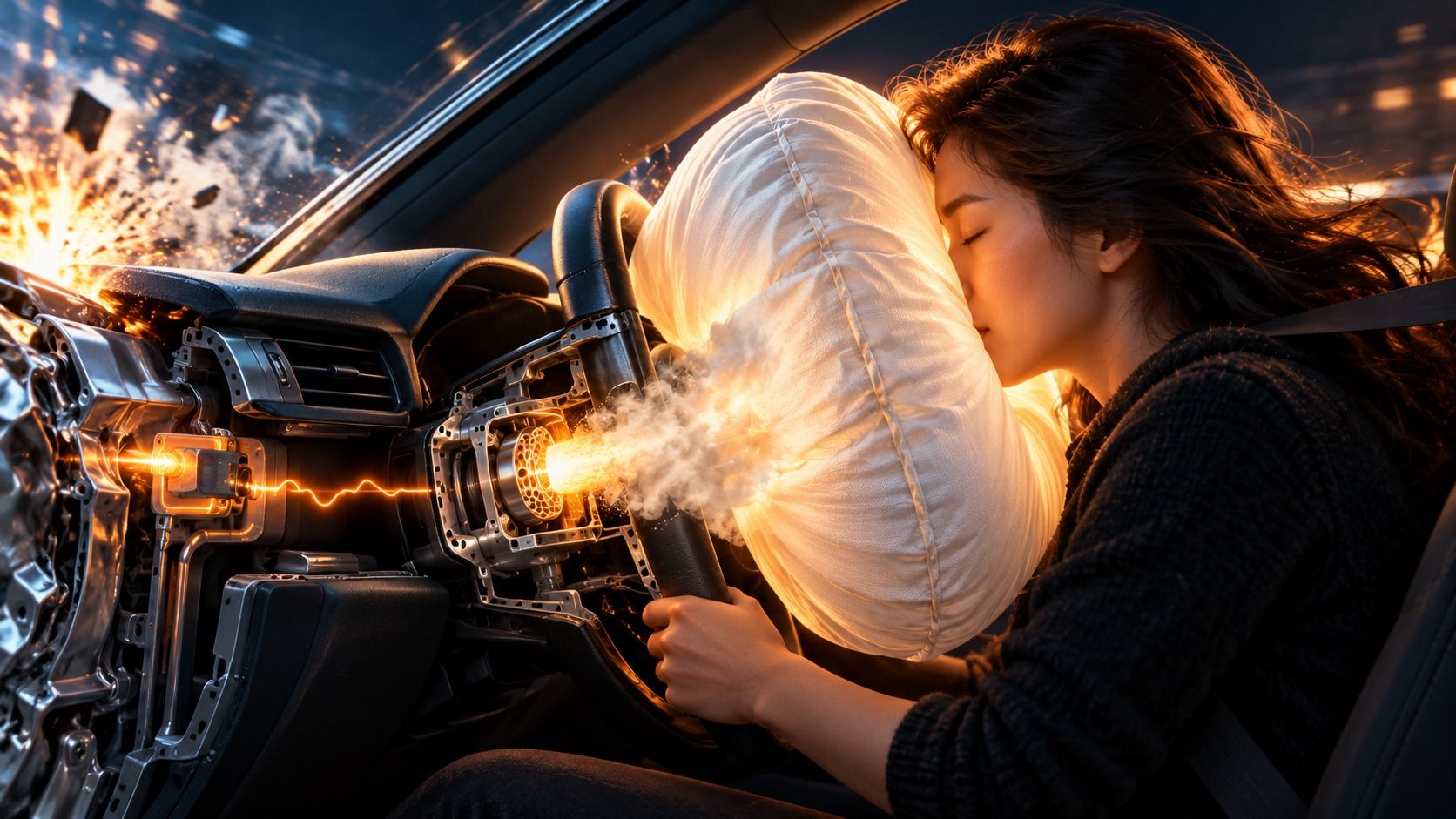
How does a car airbag work?
Sensors detect a crash and send a signal to an inflator, which uses a fast chemical reaction to fill the bag with gas in about 30 milliseconds. The bag cushions you and then deflates right away.
Sensors feel the crash
Sensors in the car measure how fast it slows down. A sudden, violent stop, like hitting a wall at more than about 20 km/h (12 mph), tells the car’s computer this is a real crash and not a pothole.
Share this stepA tiny chemical blast makes gas
The computer sends an electric signal to the inflator in the steering wheel. It ignites a small chemical charge that instantly produces a large burst of harmless gas, mostly nitrogen.
Share this stepThe bag catches you, then deflates
The gas fills the nylon bag in about 30 milliseconds, faster than a blink. Small vents let the gas escape as you press into it, so the bag slows you down gently instead of bouncing you back.
Share this stepFaster than a blink.
Sensorgascushion
The whole sequence, from impact to a full bag, takes less time than it takes to blink. Airbags are designed to work together with your seatbelt, never instead of it.
Common follow-up questions
Why do I still need a seatbelt?
The seatbelt keeps you in the right position. Without it you can hit the airbag while it’s still inflating, which can cause serious injuries.
What is the white powder after an airbag goes off?
It’s mostly cornstarch or talc used to keep the folded bag from sticking. It can irritate eyes and skin, so rinse it off, but it isn’t toxic.
Can children sit in front of an airbag?
No. Children should ride in the back seat, and a rear-facing child seat must never be placed in front of an active airbag.
How close should I sit to the steering wheel?
Keep at least about 25 cm (10 inches) between your chest and the center of the steering wheel.