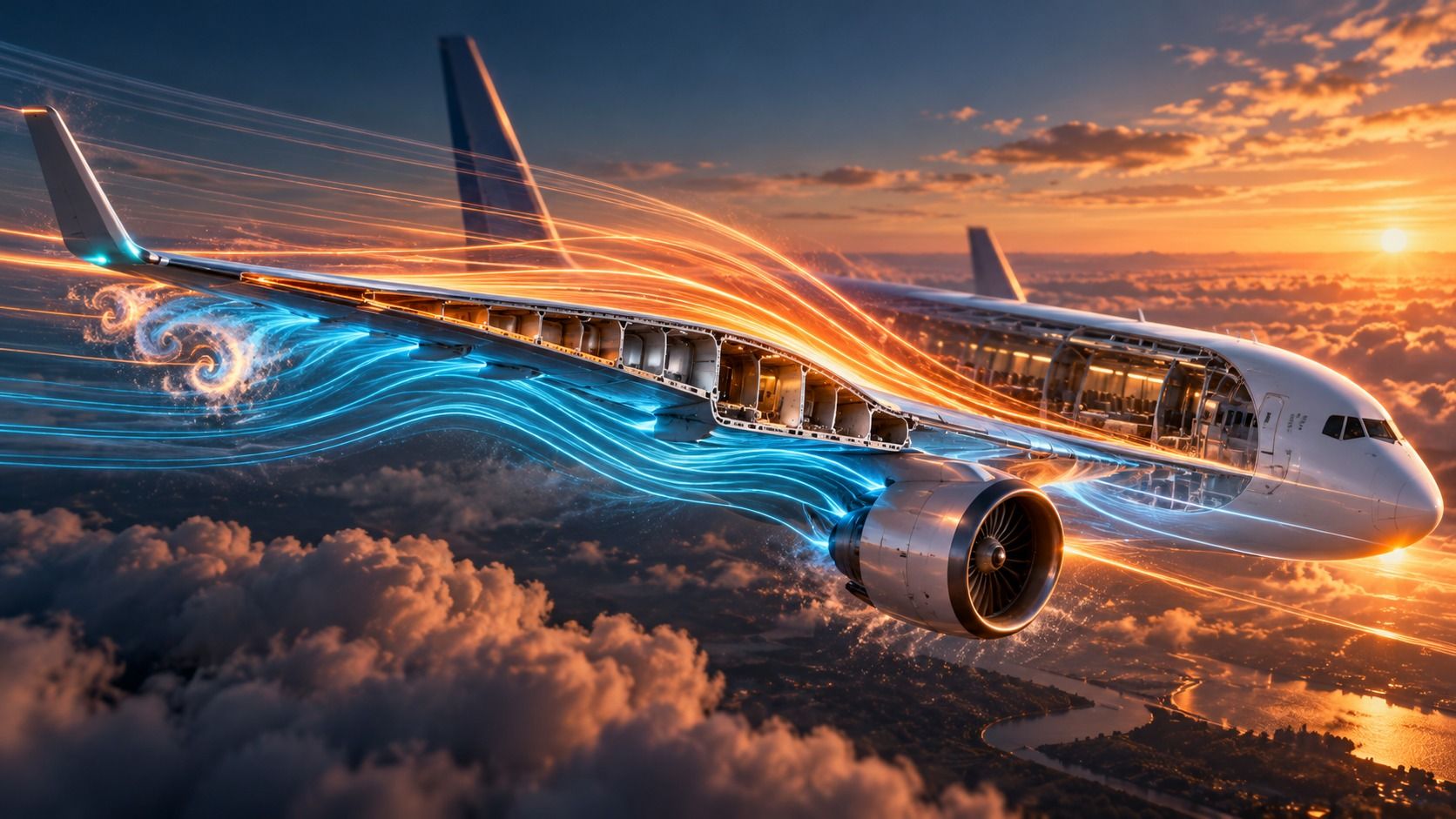
How do planes fly?
A wing is shaped and tilted so it pushes air downward. That leaves lower pressure above the wing and higher pressure below, and the plane is lifted up as long as it keeps its speed.
Pressure drops above the wing
The wing is curved and tilted slightly upward. Air following the top surface speeds up, and the pressure there drops.
Share this stepBelow the wing, air is pushed down
The underside pushes air downward. Higher pressure below and lower pressure above push the wing upward.
Share this stepNo speed, no lift
The engines pull the plane forward. Only when air flows fast enough over the wings is there enough lift to carry the plane.
Share this stepThe wing pushes air down, the air pushes the plane up.
Speedwing shapelift
The swirls at the wingtip are a trace of the same thing: air squeezing around the edge from high pressure to low.
Common follow-up questions
How can planes fly upside down?
It’s mostly about the angle. Even an upside-down wing pushes air downward if it’s tilted the right way.
Is turbulence dangerous?
Almost never. It’s just moving air, a bit like bumps on a road. Airliners are built to handle far stronger forces.
What happens if the engines stop?
The plane doesn’t drop, it glides. From cruising altitude an airliner can glide more than 100 kilometers (over 60 miles).
Why do planes fly so high?
The air is thinner up there, so there’s less drag and fuel goes further. Planes also fly above most of the weather.